Book Review and Discussion: A Day No Pigs Would Die
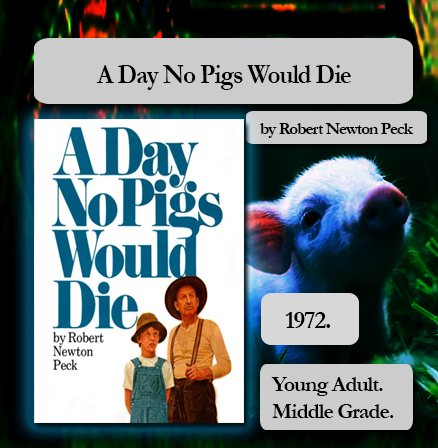
by Robert Newton Peck
Genres: Young Adult, Middle Grade, Classic


This article contains affiliate links. If you purchase using the links, I get a small commission at no extra cost to you!
Summary:
Out of a rare American tradition, sweet as hay, grounded in the gentle austerities of the Book of Shaker, and in the Universal countryman’s acceptance of birth, death, and the hard work of wresting a life from the land comes this haunting novel of a Vermont farm boyhood.
In the daily round of his thirteenth year, as the seasons turn and the farm is tended, the boy—whose time is the only-yesterday of Calvin Coolidge, whose people are the Plain People living without “frills” in the Shaker Way—becomes a man.
That is all, and it is everything. The boy is mauled by Apron, the neighbor’s ailing cow whom he helps, alone, to give birth. The grateful farmer brings him a gift—a newborn pig. His father at first demurs (“We thank you, Brother Tanner,” said Papa, “but it’s not the Shaker Way to take frills for being neighborly. All that Robert done was what any farmer would do for another”) but is persuaded. Rob keeps the pig, names her, and gives her his devotion… He wrestles with grammar in the schoolhouse. He hears rumors of sin. He is taken—at last—to the Rutland Fair. He broadens his heart to make room even for Baptists. And when his father, who can neither read nor cipher, whose hands are bloodied by his trade, whose wisdom and mastery of country things are bred in the bone, entrusts Rob with his final secret, the boy makes the sacrifice that completes his passage into manhood.
All is told with quiet humor and simplicity. Here are lives lived by earthy reason—in a novel that, like a hoedown country fiddler’s tune, rings at the same time with both poignancy and cheer.
First Sentences:
I should have been in school that April day. But instead I was up on the ridge near the old spar mine above our farm, whipping the gray trunk of a rock maple with a dead stick, and hating Edward Thatcher. During recess, he’d pointed at my clothes and made sport of them. Instead of tying into him, I’d turned tail and run off. And when Miss Malcolm rang the bell to call us back inside, I was halfway home.
My Thoughts:
This is more than likely the most personal nostalgic book I will ever review, as I was forced to read it in middle school twice in the early 90s. A change of schools in the middle of the school year was to blame for that. The school I left decided to cover the book in the fall, whereas the school I transferred to after a big move decided to cover it in the spring. It aggravated me to no end that I had literally just finished the English unit that covered this book, only to go to a new school to start the unit all over again. The story has stuck with me for a long time and I’m grateful I managed to find a copy on Thriftbook.com that had the same cover as the one I read all those years ago.
The Way it Reads
When I read it in middle school, I felt annoyed that the dialog was written exactly as the character would talk. Robert Peck’s thick dialect and lack of knowledge on how to say certain words properly is on a level with that of a second grader. I was so full of myself back then, thinking that I was better than the book on the simple premise that I knew how to speak properly. Fast forward to present-day, I can now appreciate that Robert narrates in his own spoken word, rather than placing a third-person narrative in charge of telling the story in typical, bland words. It gives it a much more authentic feeling and charm.
Profanity in my middle school curriculum?
Right into the first chapter (both reading it as a kid and as an adult), I found myself laughing at Robert’s attempt to help his neighbor’s cow give birth to her calf. Like most typical pre-teens, 12-year-old Robert is no stranger to cussing with no adults present, and gives the cow a good scolding when it won’t cooperate with Robert’s calf delivery plan.
“You old bitch,” I yelled at her, grabbing a dead blackberry cane that was as long as a bullwhip and big around as a broom handle, “you move that big black smelly ass, you hear?”
Young Robert cusses several times throughout the book, and it makes me appreciate my years in school being during a time when parents didn’t feel the need to censor their kids from every book they deemed inappropriate. Inappropriate for an elementary school student? Yes. For a middle school student? No.
Most of us should know from experience that middle school kids say much worse in their social circles than what you’ll find in this book. It doesn’t matter what generation you grew up in. As for my 8th grade English class, we would snicker at the cuss words for all of 10 seconds before moving on. It wasn’t big enough of a deal to any of us to take it further than that.
Were the Peck’s Real Shakers?
The Peck’s are portrayed as devout followers of the Shaker religion in A Day No Pigs Would Die. They live and breathe by the laws found in The Book of Shaker. While the Shaker religion was indeed one of the religions of early American history, it is strongly misrepresented in this novel.
There is no such thing as The Book of Shaker. Shakers were also not allowed to marry and have children. For more on the Shaker religion and how A Day No Pigs Would Die misrepresents the religion, check out this article. It is an excellent read!
Human Fences
“Fences sure are funny, aren’t they, Papa?”
“How so?”
“Well, you be friends with Mr. Tanner and all. But we keep this fence up like it was war. I guess that humans are the only things on earth that take everything they own and fence it off.”
I loved haven Peck’s reply to his son’s statement. He pointed out that there are plenty of other animals that build invisible fences of their own by scent marking territory, thus reaching the conclusion that humans are not so different from other animals in that regard. He also makes it clear to his son that fences do more than just establish boundaries. In Haven Peck’s eyes, a good fence not only keeps unwanted company off of their land, such as predators hungry for farm animals or people who would hurt them, but a good fence also keeps the farm animals from wandering over onto the neighbor’s land and causing damage, thus making a fence not only a necessity, but a courtesy. To me, it was a nice moment between father and son as they both presented their own perspectives while being considerate of the other.
Death is a Messy Business (Spoilers from this point on)
Haven Peck kills pigs for a living and is no stranger to death. He tells Robert that death is messy, just like birth. There was plenty of death in this book, believe me. Mid-way through the book, Haven and Rob must go to their church graveyard to confront a man who is trying to dig up his infant daughter from her grave.
The man had years earlier had an affair with a young woman and impregnated her, after which the woman drowned the infant shortly after giving birth and hung herself, as the man did not initially come forward to claim the child as his. It’s a dark theme to put in a middle grade book, and I admit I didn’t at first understand why the scene was included at all. The more I thought about it after reading it as an adult, I realized it wasn’t just wasted filler, but the scene rather seemed to teach young Rob to own up to mistakes, no matter how big of a dirty secret it may be.
The Chapter I hated the Most (spoilers)
There was a chapter that did unnerve me, but it wasn’t digging up a dead baby (believe it or not). It was the ‘weaseling’ of a dog. What exactly does that entail? Well, Haven Peck manages to catch a weasel that attacked his farm animals. Rob tells Haven that one of the neighbors has a young terrier, and the two decide to contact the neighbor to see if the dog has been weaseled.
The idea is that if a dog is forced to fight an angry weasel, it will grow to hate weasels enough to ensure that no future weasel ever gets close to the farm animals without being mauled by the dog. The neighbor brings the dog over and puts the scared little dog in a barrel, while haven dumps the angry bagged weasel into the bucket and seals it shut so the dog and weasel can fight to the death.
The poor little dog wins, but has sustained fatal injuries. Rob demands that they shoot the dog to end its suffering. The two grown men then realize they have been cruel and foolish, instantly regretting their actions. It was a lot for me as a middle school student and it didn’t hit me any differently when I read it as an adult. Nothing to see here, folks. Just a couple of foolish rednecks killing their pets for no good reason. The entire chapter angered me.
The Fate of Pinky the Pig (spoilers)
Pinky was Rob’s best friend, and he loved her with all his little heart. His plan was to breed her and sell her piglets, so that he could not only contribute to the farm, but also ensure that Pinky never made it to the butcher’s block.
That dream was shattered when Pinky failed to go into heat when she was of age. Suspecting that Pinky is barren, Haven contacts his neighbor to bring over his best breeding boar in hopes of forcing Pinky into heat.
It’s a brutal scene as the boar brutally mates with Pinky, causing her great pain. Pinky is forced to breed twice, but never becomes pregnant. Confirming that Pinky will never have piglets for the family to sell, Rob begins to realize that the chances of keeping Pinky off of the dinner table are slim, as the Pecks live in poverty and cannot afford the upkeep of keeping Pinky as a pet.
Pinky’s fate is sealed after a bad harvest of the Peck’s apple orchard and Haven’s unsuccessful attempt to hunt any deer for winter meat. The Peck family can’t afford to feed even themselves for the winter, leave alone a pig that requires a massive amount of food every day. I had always hoped for a happy ending for Pinky, like Wilbur had in Charlotte’s Web. A happy ending, unfortunately was not the aim of this book.
I truly felt for Rob, as he had to help his father kill Pinky. Despite the fact that his dad kills pigs on his own for a living, he still makes Rob help him slaughter his pet, and it is absolutely heartbreaking to read.
It’s the one scene that stuck with me for years after reading it in middle school, and even as an adult, I still cried and felt a knot in my stomach as I read the scene. I know why Haven decided to have Rob help him, as Haven knew he was sick and needed to teach Rob the harsh realities of running a farm so that Rob could take over after Haven died, but it still didn’t make it any easier to read or any less cruel.
Cruel. That is a reality of nature, especially when you’re running a farm and have to kill your own food. Especially when you live in poverty and have no other options. After Haven’s death the following winter, Rob is only 13, but now has the responsibility of running the farm and taking care of his mother and aunt by himself.
All the events of the book helped prepare him for it when the time came and gave him the strength to step out of his childhood and into the role of a man. It’s heartbreaking, but if I can say something good about this book, all the death and heartache helped further strengthen my ability to feel empathy, and I think that’s why it was a good pick for my English curriculum.
Favorite Lines:
Never miss a chance…to keep your mouth shut.
There would be no work on this day. A day no pigs would die.
I stayed there until the fire died. So it would not have to die alone.”
I’d heard about the Baptists from Jacob Henry’s mother. According to her, Baptists were a strange lot. They put you in water to see how holy you were. Then they ducked you under the water three times. Didn’t matter a whit if you could swim or no. If you didn’t come up, you got dead and your mortal soul went to Hell. But if you did come up, it was even worse. You had to be a Baptist.
“When you’re the only one to do something, it always gets done.”
Discover more from Klorrie's Corner
Subscribe to get the latest posts sent to your email.

 Klorrie's Corner
Leave a comment