
Book Review: The Butterfly Garden
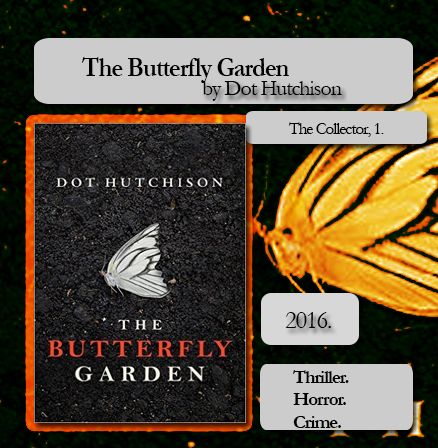
 The Butterfly Garden The Butterfly Garden |
| by Dot Hutchison |
| Series: The Collector, Book 1 |
| 2016. |
| Genre: Thriller, Horror, Crime |
 |
 |
| This article contains affiliate links. If you purchase using the links, I get a small commission at no extra cost to you! |
Summary:
Near an isolated mansion lies a beautiful garden.
In this garden grow luscious flowers, shady trees…and a collection of precious “butterflies”—young women who have been kidnapped and intricately tattooed to resemble their namesakes. Overseeing it all is the Gardener, a brutal, twisted man obsessed with capturing and preserving his lovely specimens.
When the garden is discovered, a survivor is brought in for questioning. FBI agents Victor Hanoverian and Brandon Eddison are tasked with piecing together one of the most stomach-churning cases of their careers. But the girl, known only as Maya, proves to be a puzzle herself.
As her story twists and turns, slowly shedding light on life in the Butterfly Garden, Maya reveals old grudges, new saviors, and horrific tales of a man who’d go to any length to hold beauty captive. But the more she shares, the more the agents have to wonder what she’s still hiding…
First Sentence:
The techs tell him the girl on the other side of the glass hasn’t said a word since they brought her in.
My Thoughts:
The Butterfly Garden is a book that has stuck with me for several days. No doubt, it is dark and twisted. I wanted to give it five stars, and I came very close. It’s so well written: the setting, the characters, the dialog, the tone. The main character that narrates the story has a well-rounded personality, with an intriguing backstory before her captivity, and a thought-provoking outlook on the surrounding world. My overly-sensitive, empathetic side made me cry for the young girls in the story and I went to bed in a strange funk of depression over what they endured.
The story tells of a group of young women who fall prey to a deranged man, known as The Gardner. He kidnaps young girls (usually between the ages of 16–19) and holds them hostage in a custom-made secret greenhouse, which is complete with an exotic garden, pond, waterfall and real butterflies. The Gardner tattoos the girls on their back with their own unique butterfly and gives them a new name.
These girls live out the rest of their short lives within the secret interior of the greenhouse, getting raped by the Gardner regularly, tormented by the Gardner’s sadistic son and grimly reminded of the fate that awaits them if they turn 21, get pregnant or piss off the Gardner bad enough.
Once any of that applies, the Gardner takes the unlucky girl’s life and encases her in a mixture of formaldehyde and resin, which form the walls of the garden — with their butterfly tattoo being the centerpiece of the display.
It’s a brutal picture to take in and believe me, as I got to know some of the victims in the story, I felt sick to my stomach when it was their turn to be put in the glass.
The overall theme here is the blurred line of being able to separate illusion from reality. This theme is evident in the contrast between freedom and captivity, the juxtaposition of the realness of the garden and the machinery and filters that sustain it, the conflict between denial and acceptance, the Gardner’s experience of love versus cruelty, and, most importantly, the comparison between real butterflies and the captive girls.
This book kept me engrossed in it until the very end. The very end… is what ruined it for me, I think. There is a twist that is thrown in at the very end that I didn’t see the point of. I didn’t care for it at all. It seemed so out there that I just couldn’t bring myself to give The Butterfly Garden a Klorrie Cup Award.
Why did they not just escape by overpowering their captors?
I’ve read many other reviews that have criticized the plot as being too unrealistic. The argument is that 20 to 25 girls should be able to overpower both the Gardner and his son and escape, rather than immediately submit to the situation or develop Stockholm Syndrome upon arrival.
I can see where a logical person would use this argument. The problem here is that when someone has been abducted and put into a situation like that experienced by the girls in this story, chances are high they will lose all ability to think rationally.
The explanation given in the book is because they are simply stuck in a state of fear of what would happen if they tried. They knew that if one or more of them attempted to escape, they could all be gassed within minutes. There are cameras and microphones in every corner. They have no idea what awaits them outside the garden walls and the only exit is a steel door that requires a punch code which only the Gardner and his son know.
When it comes right down to it, if they banded together and escaped that easily, then there wouldn’t be much of a story to read.
My thoughts on the character, Desmond:
(Spoilers included. You’ve been warned. )
We find out later in the book that the Gardner has a second son, Desmond, who is a lot more sensitive than his sadistic older brother. “He wants to do good, but he is his father’s son.” Even though he finds out about what his father is doing, his reaction is not to go straight to the police. He instead tries his best to buy into his dad’s bullshit explanations and refuses to see it for what it really is. He has a strong desire to make his father proud, and that is mentioned several times as his possible deterrent to do the right thing.
I think the theme I mentioned earlier is playing out with Desmond just as it is with the girls. Desmond seems incapable of separating the truth from illusion. He is in a powerful state of denial and in fear of the consequences of acting rationally, just as the girls are. The psychology of it is complicated, but not impossible. We see stuff like this all the time in the real world when a parent defends a criminal child.
Does that mean I sympathize with Desmond? Hell no, it doesn’t. Just as the girl who narrates states at one point, “I don’t really know how I feel about Desmond.” His denial and weakness make things a hell of a lot worse in the end. He just isn’t an easy guy to like and call a ‘hero’ when he eventually decides to do the right thing.
Overall, I highly recommend giving this book a read. I will most definitely be reading the rest of The Collector series.
Favorite Quotes:
“So a rose by any other name isn’t still a rose?”
Beauty loses its meaning when you’re surrounded by too much of it.
Let’s call me a shadow child, overlooked rather than broken. I’m the teddy bear gathering dust bunnies under the bed, not the one-legged soldier.
Sometimes you can look at a wedding and realize with a certain sense of resignation that any children produced in that marriage will inevitably be fucked up and fucked over. It’s a fact, not a sense of foreboding so much as a grim acceptance that these two people should not—but definitely will—reproduce.
“Some people stay broken. Some pick up the pieces and put them back together with all the sharp edges showing.”
our captor wept for the death of the one girl he hadn’t killed
“You seem to have this strange image of me as a lost child, like I’ve just been thrown on the side of the road like garbage, or roadkill, but kids like me? We’re not lost. We may be the only ones who never are. We always know exactly where we are and where we can go. And where we can’t.”
“My secrets are old friends; I would feel like a poor friend if I abandoned them now.”
Sometimes the illusion of freedom, of choice, was more painful than captivity.
it’s a Greek tragedy, and the Greeks and Shakespeare really love killing people off. It’s a great lesson, really. Everyone dies.”
The trouble with sociopaths, really, is that you never know where they draw their boundaries.
Yet if hope has flown away in a night, or in a day, or in none, is it therefore the less gone? All that we see or seem is but a dream within a dream.
I don’t choose to be sad or pissed off, but I don’t exactly choose to be happy, either.
“Not making a choice is a choice. Neutrality is a concept, not a fact. No one actually gets to live their lives that way.”
And that stupid little girl stood in the winter and kept lighting matches to catch glimpses of families that weren’t—could never be—hers and froze to death in those harsh moments of reality between matches, because even though matches can burn, they’re light, not heat.
“My father took me to New York and arranged for me to spend a few days with a professional violinist, to see what it would be like. I hated it. It all felt . . . well, soulless, I guess. Like if I actually did that for a living, I’d grow to hate music.
“The gifts we give say as much about us as the gifts we get and keep,”
Other than the knickknacks, it was hard to say the room reflected anything about me, as I hadn’t chosen anything about it. Even the trinkets were hard to pin down, really. Evita had once painted me a lovely chrysanthemum on a rock, but that showed her sunny personality, not mine. My keeping it just meant that she was important to me.
“I’m not a fake person; I’m carefully and genuinely handcrafted.”
Because Courtesy is as much a bitch as Disdain.
“If there’d never been a Garden, if you’d met him at the library or something, do you think you’d love him?” “Honestly? I don’t think I know what that kind of love is. I’ve seen it in a few others, but for myself? Maybe I’m just not capable of it.”“I can’t decide if that’s sad or safe.”“I can’t think of any reason it can’t be both.”
Other people got to look at a birthday and say, “Yay! One year older!” We met our birthdays with “Fuck. One year less.”
Buy The Butterfly Garden Now on Amazon!
Discover more from Klorrie's Corner
Subscribe to get the latest posts sent to your email.

 Klorrie's Corner
Great book to read when you have to. Besides that I simply actually like this book. A satisfaction to read from the very first page to the last. I likewise suggest to check out http://bit.ly/2L5b3Z0 . Thanks P.S: I like your blog.
LikeLike